Klicke hier für die deutsche Übersetzung
Blood, Gods, and Broken Promises: We Who Will Die Starts Strong but Loses Its Edge
Stacia Stark’s We Who Will Die begins with the kind of opening that immediately sharpens a reader’s attention like a blade against stone. The first several chapters are genuinely gripping: brutal, tense, emotionally charged, and anchored by a protagonist who initially appears wonderfully hardened by circumstance. Arvelle, or Velle, is introduced as someone forged in grief and survival. She has lost her mother to addiction, lost her best friend in gladiatorial combat, and has spent years carrying the crushing responsibility of raising her two younger brothers in the impoverished Thorn district, one of whom suffers from a debilitating lung condition. Add to this the lingering wound left by Ti, the boy who abandoned her 6 years ago, and Velle should have emerged as a deeply scarred, fiercely guarded survivor. And for a brief while, she does.
Unfortunately, that compelling characterization slowly unravels as the story progresses.
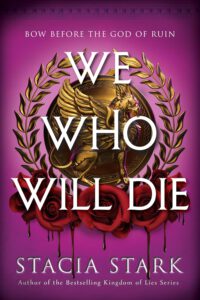


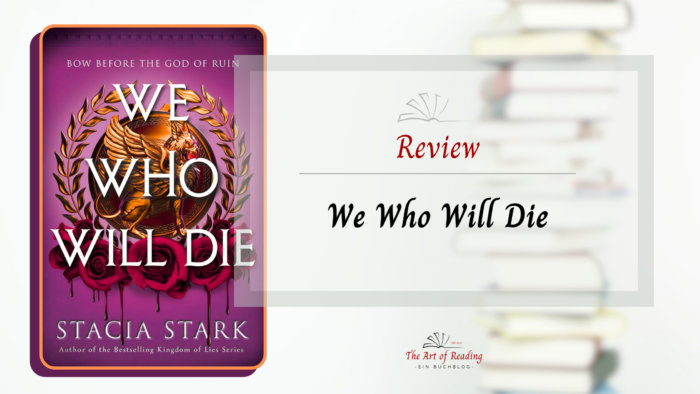
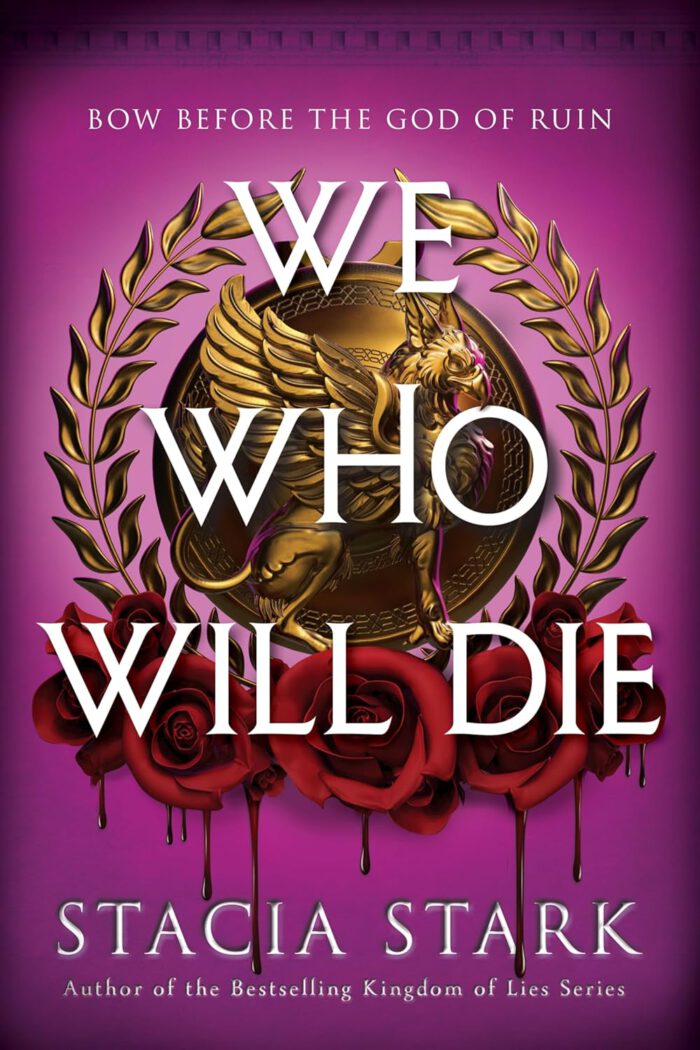
We Who Will Die by Stacia Stark
Series: Empire of Blood #1
Genre
 Der Begriff Genre bezeichnet eine Kategorie oder Gattung von... More: Epic Fantasy, Gods, Romance, Vampires
 Published on 30. Dec 2025 by Avon
Pages: 420
Format: Kindle Edition
ASIN: B0F2JKM4FL
Language: English
Source: Amazon
My rating: | Spice:

Life in the perilous Thorn district is a constant battle for Arvelle and her younger brothers. And the vampire standing on her doorstep is about to turn their world upside down.
Faced with an unthinkable choice, Arvelle makes a magically binding vow to do the kill the emperor, an ancient vampire created by the god Umbros. But first, she must enter the Sundering—an arena where only the fastest, strongest, and deadliest survive long enough to be selected for the emperor’s elite guard.
She quickly draws the ire of the Primus, the powerful figure charged with protecting the emperor. But the vampire under the armor is the last person Arvelle expects to encounter in the emperor’s court.
With her brothers’ lives in the balance, Arvelle has no choice but to ally with the man who once shattered her heart… and with the emperor’s sadistic son, Rorrik—two vampires whose motives are impossible to pin down. Rorrik holds the key to understanding the powers Arvelle is developing—abilities that would put a price on her head if discovered by the emperor.
To survive the arena and complete her mission, Arvelle must get to the bottom of a conspiracy that will change everything she thought she knew about herself—and the two vampires who are deeply entwined with her destiny…
Buy here: Amazon*
Find the Author: Website, Goodreads, Amazon
Icons made by Freepik from www.flaticon.com

We Who Will Die ♦ Stacia Stark
A Review
Opinion
The greatest issue with this novel is not its premise, because the premise is excellent. A young woman coerced into swearing a magically binding vow to assassinate the emperor while surviving a deadly arena competition already sounds like fertile ground for political intrigue, betrayal, and emotional devastation. The problem is that Velle herself becomes increasingly inconsistent. The woman introduced in the opening chapters feels calculating, sharp, distrustful, and emotionally armored. Yet once she enters the larger conflict surrounding the ludus and the imperial court, she repeatedly makes bafflingly naive decisions that directly endanger not only herself but others around her. At times, it genuinely felt as though she had “misplaced” the hard-earned instincts her traumatic upbringing should have carved into her.
This disconnect became especially frustrating because Stark continuously reminds the reader of Velle’s suffering and resilience. We are told repeatedly how hard life has made her, how impossible it has been for her to grieve properly, how survival has demanded emotional numbness. Yet her actions often contradict that entirely. Instead of behaving like someone conditioned by years of hardship and betrayal, she frequently stumbles blindly from one mistake to another. Several of these errors even lead to deaths that might have been avoidable. Rather than feeling tragic, these moments often felt preventable in ways that weakened my investment in her journey.
Then there is the matter of the Primus.
The instant this mysterious armored figure began showing unusual interest in Velle at the ludus, the reveal became painfully obvious. My first thought was: “That’s Ti.” And indeed, Tiernon turns out to be exactly who he appears to be. The issue is not necessarily that the twist was predictable, because predictable twists can still work if the emotional payoff lands. Here, however, the emotional core never truly materialized for me. I never genuinely felt the anger Velle supposedly carried toward him for abandoning her, nor did I believe their reconciliation once the truth came out. Their history is constantly referenced, but rarely felt.
The second revelation surrounding Tiernon was equally transparent. The moment he spoke casually with Rorrik, the emperor’s heir, in a manner utterly devoid of rigid class hierarchy, it became immediately obvious that the two were brothers, both sons of the emperor. Highlight to see spoiler And with that realization, the narrative drifted into a familiar love-triangle dynamic that made me internally roll my eyes rather hard.
Ironically, Rorrik ended up being by far the more compelling of the two male leads.
Where Tiernon feels strangely bland beneath all the descriptions of towering muscles and intimidating physicality, Rorrik possesses something far more valuable: ambiguity. His motivations remain elusive throughout much of the novel, and there is a constant uncertainty surrounding where his true loyalties lie. Unlike Tiernon, whose role increasingly settles into recognizable romantic fantasy Fantasy ist ein Teilbereich der Phantastik und leitet sich v... More territory, Rorrik feels dangerous in a more interesting way. From the beginning, he knows exactly why Velle is in the ludus: to kill the emperor and save her brothers from the vampire blackmailing her into obedience. That awareness creates tension every time he appears on page. He was one of the few characters who consistently held my attention.
The world-building, meanwhile, feels oddly underdeveloped considering how ambitious the setting tries to be.
The novel constantly references Sigilmarked individuals, ancient gods, divine powers, curses, and political structures, yet many of these concepts remain frustratingly vague. Even by the end of the book, I still did not feel I truly understood what the Sigilmarked actually were. Likewise, readers are bombarded with mentions of various gods whose significance is barely explored. Mortuus and Umbros receive some degree of explanation, but many other references feel tossed into the narrative without sufficient grounding.
This becomes especially noticeable because the prose often prioritizes physical sensations over concrete detail. Velle is constantly sensing something: prickling skin, sweat gathering at the back of her neck, hairs standing on end, invisible tension curling through the air. But these sensations rarely translated into emotional immersion for me. Instead of feeling her fear, rage, desire, or desperation, I often felt oddly detached from them.
In fact, only two moments genuinely affected me emotionally: when Leon, her mentor, is gravely injured during the assassination attempt, and when Velle finally reads the final letter left behind by her friend. Those scenes carried actual emotional weight. Outside of them, most of the novel remained emotionally flat. The anger never burned hot enough, the fear never truly suffocated, and the romance never managed to spark convincingly. Even scenes clearly intended to convey longing or affection often felt strangely mechanical.
That said, the novel is not without intriguing elements. I strongly suspect Velle is secretly the daughter of Mortuus himself. The timeline surrounding Mortuus’s last freedom before her birth, combined with her mother’s refusal to identify her father and several smaller clues scattered throughout the story, point heavily in that direction. Highlight to see spoiler Whether this theory proves true in later installments remains to be seen, but it was one of the more engaging mysteries woven into the narrative.
And credit where it is due: the ending twist involving Bran, the vampire who blackmailed her, genuinely surprised me. That reveal was cleverly handled and managed to inject much-needed energy into the final stretch of the novel. It was one of the few moments where the story successfully caught me off guard.
Conclusion
Ultimately, We Who Will Die is a frustrating read because the ingredients for something extraordinary are clearly present. The premise is strong, the opening chapters are excellent, and certain characters and twists hint at a richer story beneath the surface. But the inconsistent characterization, predictable reveals, emotionally muted romance, and under-explained world-building prevent the novel from fully delivering on its promise.
I am still undecided about continuing the Empire of Blood series. There is enough intrigue in the overarching story to tempt me onward, particularly regarding the gods, Velle’s origins, and Rorrik’s true intentions. But emotionally, the novel often felt like wandering through fog: shapes existed, movement existed, but very little truly reached me. A pity, because beneath the ash and blood, there is clearly a stronger story struggling to break free.
Empire of Blood
Series

| We Who Will Die (#1) | We Who Will Rise (#2) |
| … |
About Stacia Stark

Stacia Stark is a New York Times, USA Today, Sunday Times, and Amazon bestselling author of fantasyFantasy ist ein Teilbereich der Phantastik und leitet sich v... More romance. Her books have been translated into over 16 languages, and her Kingdom of Lies series was nominated twice for Goodreads Choice Awards.
Stacia loves writing romantic fantasyFantasy ist ein Teilbereich der Phantastik und leitet sich v... More filled with found families, female friendship, self-reliant heroines, and brooding, grumpy heroes. When she’s not writing or exploring the world, she can usually be found sprawled on her sofa, lost in the pages of a good book.
This review was also published at:
It would be nice if you could rate my post. 😍
Views: 2